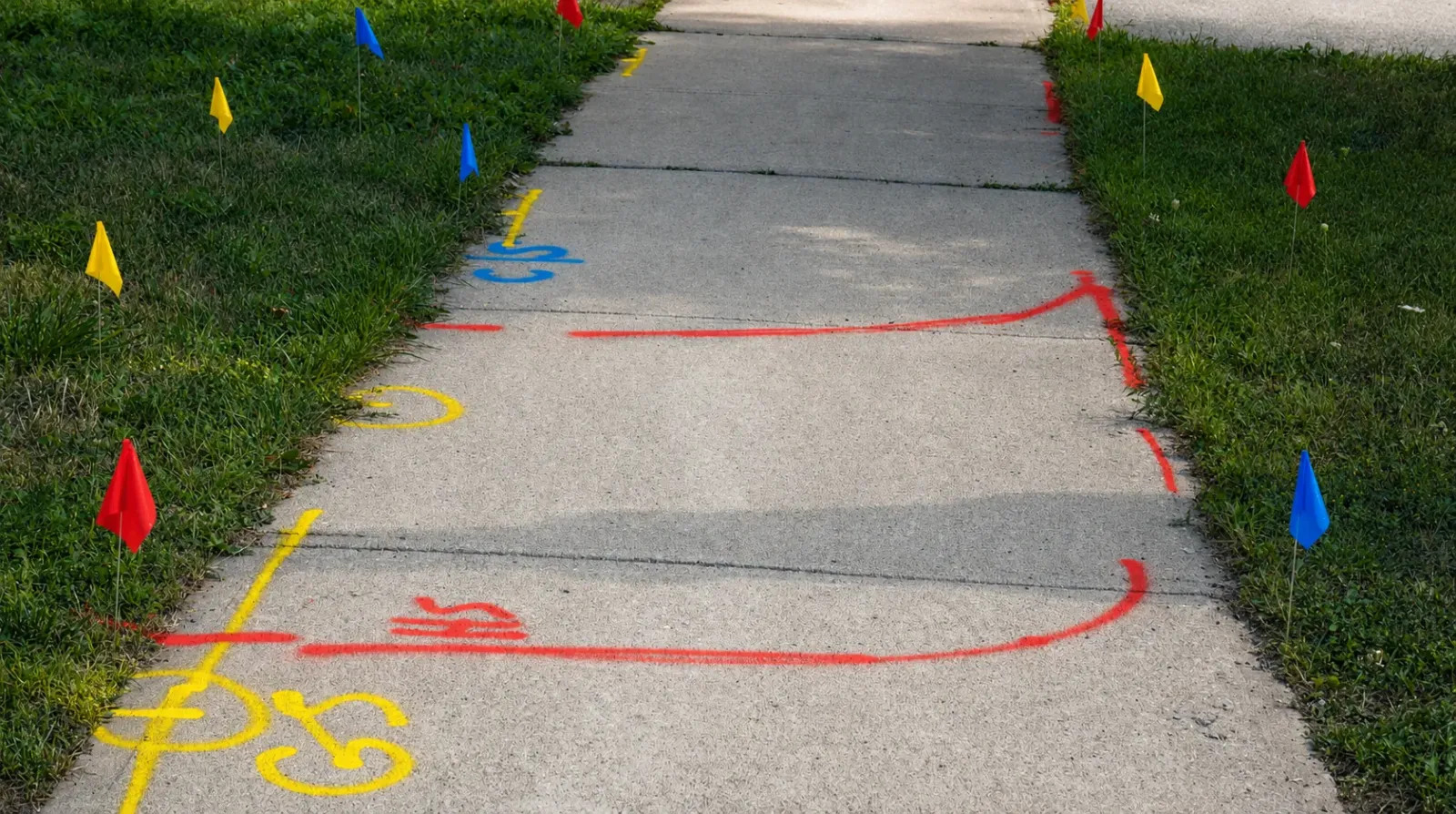
In the United States, 811 is the free national "call before you dig" number. Every state requires it by law before any excavation — from a fence post to a highway project. Most people know to call. Few know what happens next. Here is the process your call sets in motion, and the careers built around every step.
Step 1: Your call becomes a dig ticket
When you contact 811, the one-call center records where you plan to dig, when, and how deep. That request becomes a dig ticket — a work order with a legal clock on it. The center notifies every utility that owns lines near your dig site.
Step 2: A clearing center routes the ticket
Utilities and locating contractors receive thousands of tickets a day. Clearing center operators and locating dispatchers screen each one, clear tickets where no conflict exists, and route the rest to field locators — deciding who goes where, in what order, before the deadline.
Step 3: A locator marks the site
A field locator traces each buried line with an electromagnetic receiver and marks it with paint and flags in the APWA color code: yellow for gas, orange for telecom, blue for water, green for sewer. This is precision work — an underground utility line is damaged once every few minutes in the U.S., according to Common Ground Alliance damage reports, and accurate marks are the main defense. Curious about the trade? Read how to become a utility locator.
Step 4: Complex sites get daylighted
When a mark isn't enough — deep utilities, congested corridors, conflicting records — crews expose the line itself with pressurized water and vacuum excavation. The technique is called daylighting, and it's the specialty of hydrovac crews.
Step 5: The dig proceeds — carefully
With marks on the ground, excavation can start. Crews must hand-dig within the tolerance zone around each marked line. If the marks fade or the job runs long, the ticket is refreshed and the locate happens again.
Every step is a career
Dispatchers, clearing center operators, field locators, hydrovac operators — the 811 system runs on trained people, and utilities across the U.S. are hiring for all of it. CUTI trains every role in that chain, starting with the Utility Locating & Damage Prevention program: 4 weeks of training, a paid practicum, and $0 tuition with employer sponsorship.
Want to be the professional on the other end of the call? Train for the damage-prevention careers the whole industry depends on.
See the program →